
What’s the Worst Thing Someone Said While You Were Grieving?
When I put this question out on Threads, I couldn’t have predicted the responses. Not just the sheer amount of them (up to 5.4k now and still ticking up), but the absolute horror of what some people said. To children. To the newly grieving. To close friends or family members. Or the people who just…split. In the span of about 2 days, I read through thousands of comments, coming back for little bites throughout my day and crying every single time.
I shared (one) of my own horrors: “A man I only knew by name, cornered me while I was sorting my recycling, maybe the month after my daughter’s terminal diagnosis: ‘Her disease might be caused by some unconfessed sin in your life.’ I wish I had the wherewithal to smash the end off a glass bottle and scream like a banshee.”
Unfortunately, I’m not alone in being on the receiving end of atrocious and unfeeling comments.
Some of the most “liked” shares:
“My dad died in the hospital, cancer. When the Dr told us, I broke down. My mother, of all ppl, said " what are you crying for, you still have a husband". I replied, " you can get another husband, I can't get another father". -threadhead
“At least you still have two other children.” -annam46
“When my grandfather died, a coworker said, ‘It’s too bad he never accepted Jesus as his savior.’ At 80, my grandfather used to walk down & up 3 flights of stairs daily to feed the neighborhood feral cats. He was Jewish & considered it a mitzvah. I replied, ‘My God isn’t that cruel.’” -thewitchintheglen
“After my Husband died (I was 22 years old, we were married six months it was awful) more than one person told me ‘OH you’re young, you’ll get married again.’ His family called asking a million questions ‘Did he have money I didn’t know about?’, ‘Are you pregnant?’” -cardenasdl
What struck me wasn't just the cruelty. It was the repetition. The same phrases, across thousands of strangers, across decades of loss. That's not a collection of bad moments. That's a pattern.
I captured hundreds of comments and categorized them into the most common phrases and types of responses people received while grieving.
Here's what I found:
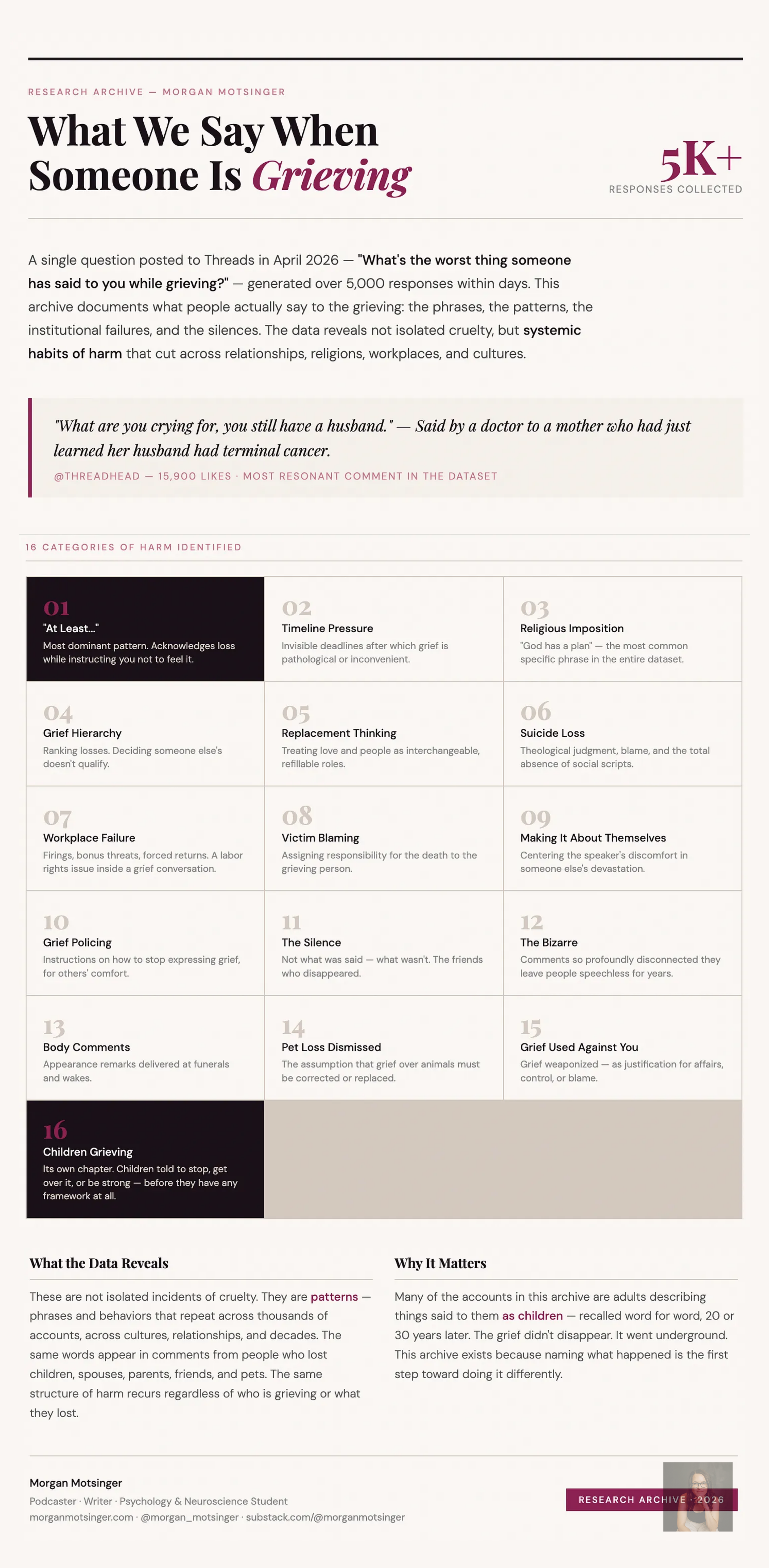
Most of the people who said these things weren’t monsters. They were people carrying their own grief, which they were never allowed to feel. People who couldn’t tolerate sitting in someone else’s pain because they’d never been allowed to sit in their own. People who needed to fix it, because if they could fix it, maybe it wasn’t so terrifying. Maybe death and loss and the randomness of suffering could be reasoned with, timed out, silver-lined into something manageable.
I recognize myself in that. I’ve said versions of these things. Maybe you have too.
What the data shows we actually need when we’re grieving is surprisingly simple: presence without agenda. Acknowledgment without reframing. Someone who can sit in the wreckage with us without rushing to a positive spin, a theological framework, or a deadline.
If you’re reading this wincing at something you said - a careless “at least,” a phone call you never made - repair is nearly always an option. It doesn’t have to be perfect. I’ve been thinking about what I said when you were grieving. I don’t think I showed up the way you needed me to. I’m sorry. That’s it.
Some of the wounds in this dataset are decades old. People recalling exact words, exact settings, exactly how old they were. The grief didn’t go away. It just went underground. We heal in community. We always have. It takes someone witnessing it - both the initial injury and the way they've carried it for so long - but compassionate presence now can work wonders on even the deepest scars.
About the author
I'm Morgan Motsinger. I hold a BS in Psychology with a minor in Neuroscience from Portland State University, and I host P.S. We Expire, a podcast about grief, death, and what it takes to live well anyway. I also spent fourteen years caring for my daughter Anni, who died in 2022 (MPSIIIa). I write about grief from both sides of that — what the research says, and what it's actually like inside. Nothing here is medical advice, and I'm not a clinician. It's the explanation I wish someone had handed me.